Ok, it’s time I put together material to counter the idea that many liberal-leaning folks have that it’s all a matter of Trump and MAGA. First though, I do want to say that I have nothing good to say about Trump. He is doing not just really stupid and mean-spirited shit, but a number of his initiatives are destructive in all sorts of ways (and in fact hastening the downfall of the American Empire). But the idea that he and his minions are solely responsible for the deteriorating state of the union just isn’t true. Trump is not a cause, but a symptom. Things have been unraveling for significant segments of our society for some time. And by that I mean the economy and the government (The System) have not only ceased to further the lives of many Americans, but has recently have had increasingly negative effects.
The MAGA movement, that Trump exploited for his own political gain, must be seen in broader terms as a populist movement. Such movements emerge when the system in which they operate fails significant portions of society (see Turchin for instance to do bring in refs). They grow out of the soil of frustration. And one major factor leading to this frustration includes the stalling of economic opportunity for the working class.
Some will point to elements of racism in MAGA. And there may be some, but I would say it’s more a matter of scapegoating. The backlash against immigration – a phenomenon that has occurred before in our past (to do refs to including No Nothing Party and the like) – is in part tied to a loss of well-paid, middle-class jobs. Of course this can be seen as based on faulty logic. But populism has always had its basis in emotion, not intellect. There has always been an element of anti-intellectualism. Which then leads to a distrust of and reaction to the “the powers that be,” politicians responsible for policy decisions as well as those who head our economy, the corporate leaders and the financial elite.
Listen to these words from former Secretary of Labor Robert Reich, in an interview that came in the wake of the recent upset in the NY Mayoral race:
The Reason People Are Fed up With Democrats – YouTube
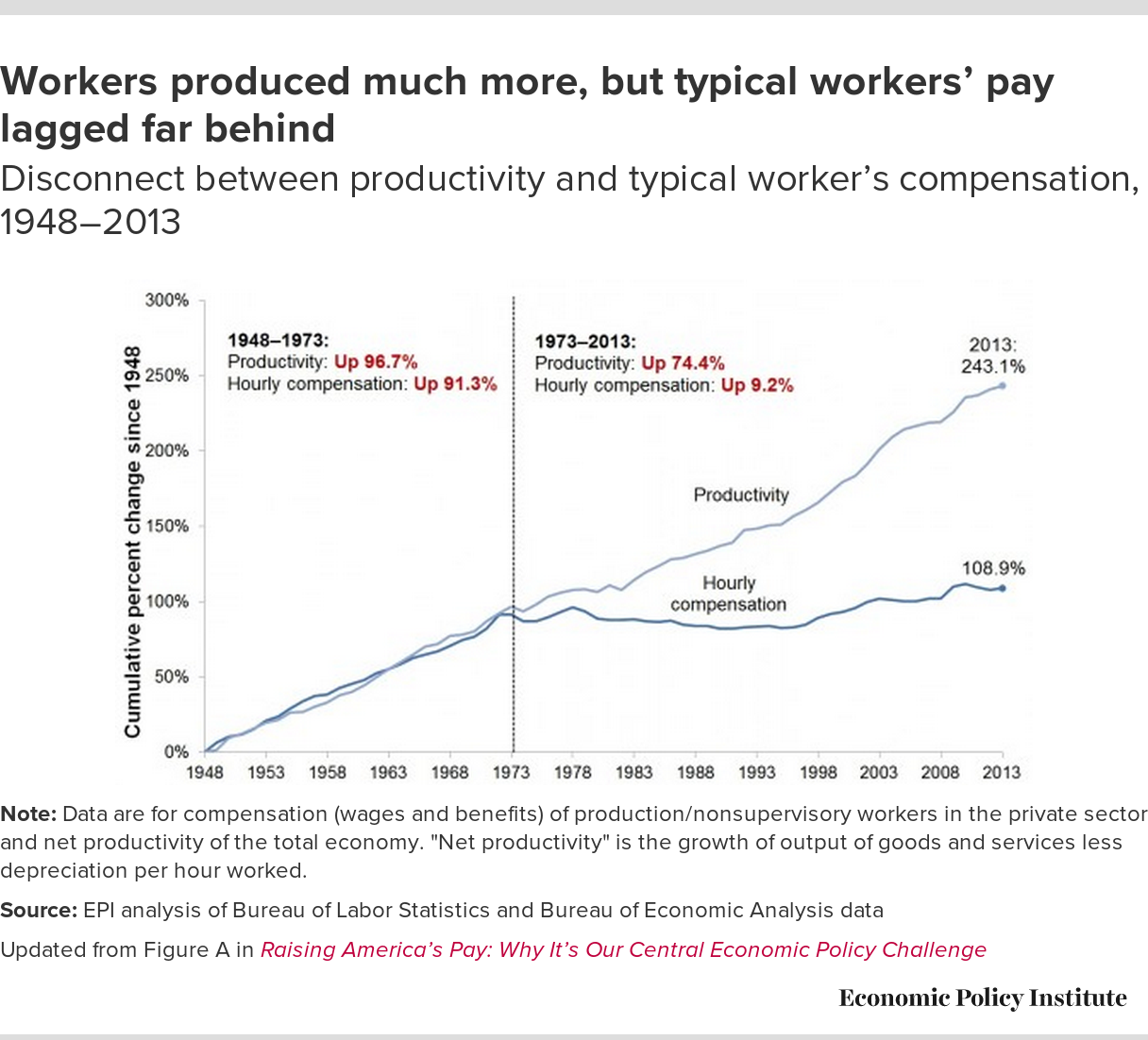
He begins by saying there is a very large wave of anti-establishment (anti-elite) sentiment in this country. Why? Now this is where some need to start paying attention. Being conservative, “the bottom 60% of Americans have not seen a real wage increase in 45 years.” In the chart found below note the divergence around the mid-1970s. The following study by Pew Research – real wages “have barely budged in decades” – is one supporting reference.
As Reich notes, many in that 60% (or so) group have done marginally better in that period, although this recently has begun to change (for the worse). But the bulk of new wealth creation since the 1970s has gone to the top tiers. A recent study by the RAND corporation, presented by Time magazine in this article, presents the same situation from another angle. The authors of the RAND study determined that from 1975 through 2018 roughly $47 trillion had been siphoned off by the top 1% from the bottom 90%, based on (and I am grossly summarizing) if income had kept up with things like productivity (as the following chart details).
As Reich continues, “The economy is rigged.” Against the working class. A situation that Bernie Sanders for example has been warning about. The following graph by the Economic Policy Institute presents data concerning this.
There are some analysts/experts who see a different picture. But you don’t have to do much searching to realize that something has gone wrong. For starters, there is a growing number of young adults who are definitely in worse financial shape than their parents at a comparable age. The prime example would be with housing, where we find the lowest affordability on record. Recent surveys show a decline in sentiment around questions such as “Do you believe in the American Dream?” (of course, we need to pin down what the Dream actually means; in this context it means the ability to have a comfortable life with the ability to save and move up the economic ladder) And such decline is higher among young adults, who find themselves increasingly priced out of the housing market.
Reasons for the Frustration
A number of developments have been identified that have led to the conditions giving rise to this frustration. Many of them have their roots in the mid-1970s, early 1980s time frame. They all had a part in the stalling of working-class wages.
A decline in union membership is one such factor. Unions gave workers bargaining power. But particularly during the Reagan administration they came under attack (including from hostile policy) and lost membership. A number of reasons have been given but behind the scenes there was the simple desire by the corporate elite to increase profits. These profits of course led to increased compensation to that elite.
The attacks on unions was part of a more general push by the elite to further their wealth. They were aided by a political shift embodied in the Reagan era that has been given the term neoliberalism, that saw free-market capitalism as the best approach to achieve general and increased prosperity. While it was touted that giving the markets free reign would benefit everyone, in practice it was only… the corporate and financial elite who saw the bulk of the fruits of these sorts of policies. Except for those involved in the so-called information economy, labor in general saw at best a stalling of opportunity; many working class saw their economic standing begin to deteriorate. Especially those who were the victims of the following:
Another major factor was the push for off-shoring (globalization). And much of this involved manufacturing. This is a major topic in itself, but one main outcome involved a segment of the American working-class who found themselves screwed. For one, a number of factory workers lost their jobs. For the rest of them, there was downward pressure on wages (given the number of such workers now trying to find work in a sector with fewer slots). And there was another outcome: the so-called Rust Belt, a kind of industrial wasteland filled with shuttered factories… and shattered communities that had thrived on that type of work. It is no coincidence that such regions provided much of early adherents of the MAGA movement. Something obvious I have not encountered in discussions on globalization should be noted: namely, the workers and related communities had no say in this major upheaval. It was thrust upon them.
Along with globalization came its twin, financialization. One facet of this was the prioritization of the shareholder (of stocks) over the worker. In addition to the rise of importance of the CEO and top C-suite execs. (to do: data )
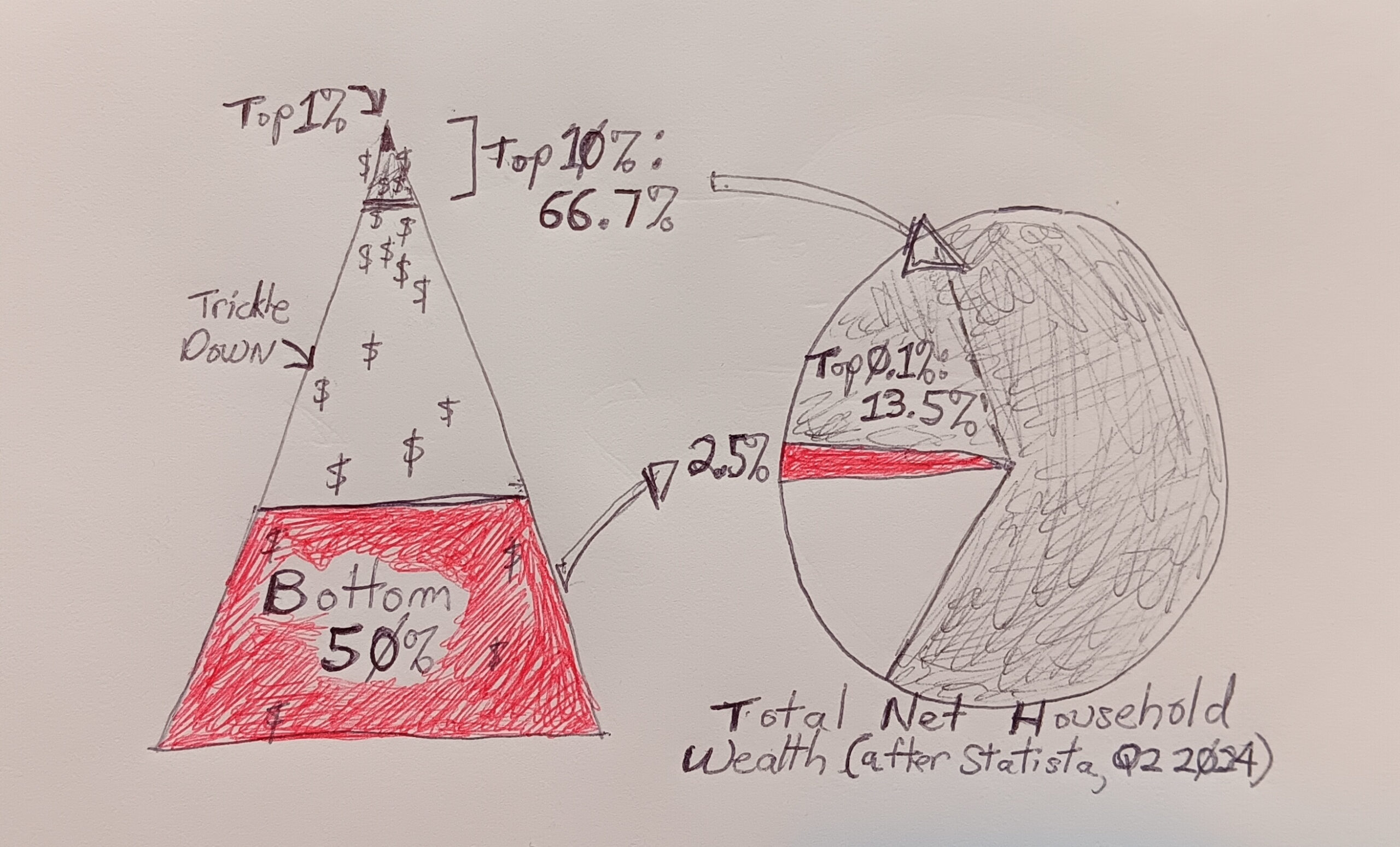
And one major result of all this has been the diminution of the middle class, as well as the related increase of wealth inequality. This pie chart by Statista illustrates this inequality as of mid-2024. This chart is augmented in the following illustration to emphasize the huge discrepancy in our society in terms of the size of the income tiers. It reinforces the scenario that the wealth enjoyed at the top “thins out” (“trickles down”) as we descend through the income tiers. The working class, and lower parts of the middle class, have increasingly found themselves scrounging around for scraps.
I won’t go into making the following connection more explicit, given it would entail a lengthy explanation, but it is no coincidence that with the diminishing of the middle class there has been an increase in political polarization. The middle class has acted as a kind of buffer from the more extreme ends of the political spectrum. With the decline of such buffering, and increase in economic frustration, we have some of the critical elements of a political backlash.
The Election of 2024 and Bidenomics
To return to the political angle, we must revisit the last election where the major issue was the economy.
It was interesting during the run-up to the election to view the divergent takes on how well, or badly, the economy was fairing. On one hand Biden and top officials and much of the MSM touted not just a robust economy, but even a fabulously booming economy. Not a few still hold to this view. The government policies were collectively given the moniker Bidenomics. It included a bill that passed Congress called the Inflation Reduction Act. But in looking beyond the overjoyed commentary and headlines… it was really mainly a matter of deficit spending. Part of this spending included creating large numbers of government jobs (to do – numbers). These jobs along with other government spending helped in the GDP calculations, leading to healthy prints. And so we got overblown statements as to how great everything was for most Americans. The problem was, many of those Americans didn’t agree with this assessment.
In survey after survey, the majority said the economy sucked. In the run-up to the election, polling found a solid 60% in swing states who agreed with the statement that “the economy is on the wrong track.” Larger %s were concerned with the cost of living. The MSM responded with commentary as to how many of such respondents were being misled or were delusional. If any of those just mentioned respondents heard such talk, it backfired. It only reinforced the skepticism (at best) or even hostility many in this group had toward those in charge, or their mouthpieces. Perhaps they still had a job, but they could sense, via their bank account and bills, that they were at best barely keeping their head above water.
On top of the foregoing was the Kabuki theatrics of the Democratic Party. Who attempted to portray a vigorous president who was not evincing signs of cognitive decline. Who then realized – too late – the charade could not be maintained, and in sudden moves removed Biden as their presidential candidate and literally thrust Harris onto the stage.
In a sense, Harris lost because of multiple charades. Even if many Americans couldn’t fully articulate them, they sensed something was “off,” that all the data that was presented that supposedly “proved” things were swell for the majority couldn’t negate.
The larger problem, however, is that that sense of something being “off” was (and is) based on cracks in The System that had developed well before the present situation, and are beyond the means of the current political system to address. Details of such cracks are found in posts and commentary throughout this site.
Of course, there is even larger problem. And that is even coming to terms with the foregoing will most likely do nothing to change the situation. Some of the “solutions” being touted by the Trump administration (such as tariffs) will probably end up making the situation even worse. This is, in my view, the tragedy of America, stumbling toward an end game – to be discussed in later posts.
References
Foreign Affairs – magazine, March/April 2025 issue
Two articles in particular, The Broken Economic Order and The Post-Neoliberal Delusion (and the Tragedy of Bidenomics) reinforce the material presented above.
The Revolt of the Elites by Christopher Lasch
This 1995 work gives a warning for society and democracy when an elite gains too much power and wealth and disengages from a large part of the population. Their wealth can insulate them from the reality of the working and middle classes. The elite can also fall into a trap of becoming enveloped in contentious issues that a lot of the population are not necessarily invested in, at least in wholehearted way.
Deer Hunting with Jesus
Strangers in Their Own Land