Category: Unraveling

  • On the Precipice – Fall 2025

    Something big is going to happen…

    Whew… after attempting to keep up with all that is going on, I feel exhausted! It’s similar to when I had a blog on hardscrabblefuture.com some years ago, in response not just to the first Trump presidency (what his win signified) but other events and trends that pointed to an uncertain, and problematic, future. I eventually abandoned it from the relentless onslaught of these events and trends. It was simply too much, and to just enumerate each event and crisis with at least possible significant implications became pointless. The forest was lost, and instead I was lost in the trees.

    The onslaught has only changed in scale. Trump’s second term has been one vast disruption, from massive tariffs/ trade wars to aggressive use of ICE and the National Guard of some states. And now we have the longest (or close) government shutdown in history (with many side effects – the cancellation of SNAP benefits being one of many). But all this chaos and divisiveness are only part of the story. There is the vastly overvalued stock market in the midst of a bubble (AI), whose popping could be a major disruption in itself, the rising number of consumers experiencing financial distress (with record, and rising, debt levels and delinquency rates)… and that’s just for starters.

    In the face of all this there is a question that keeps popping up: how long can this go on? That is, how long can this situation continue before… the cracks become full-blown breakages. Beyond the low levels of consumer confidence (such as marked by University of Michigan) and political polls that by themselves are flashing warning signs, there is less quantifiable and anecdotal evidence that a growing unease is taking hold in the country. In various contexts you can hear references to things like a major market crash or a financial crisis (with private credit for example), or a clash with ICE leading to deaths and further disturbances… or even to a new civil war (recent polls give results showing anywhere from 40% to 57% believe such a war is likely or somewhat likely). As such, we can liken our situation to a precarious teetering on a…

    Precipice

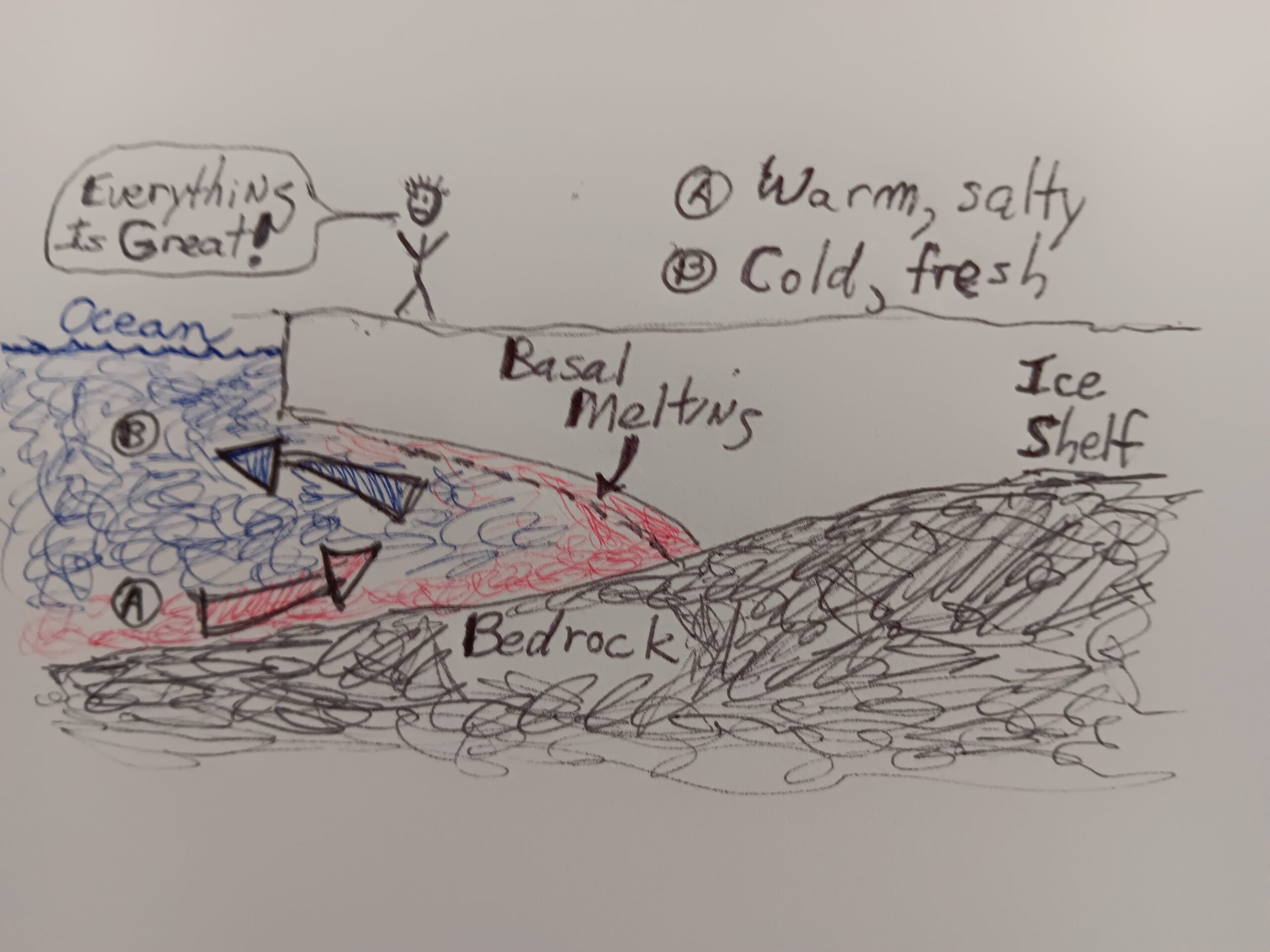
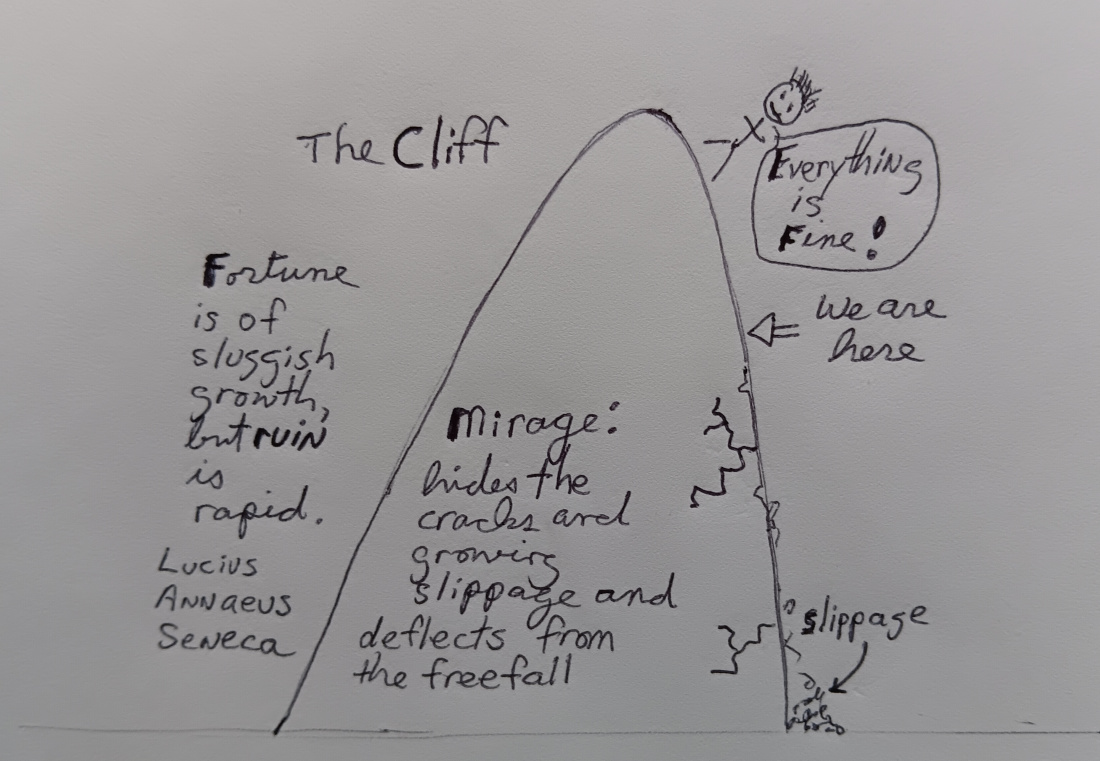
    This idea is captured by the drawing at the top. For one, even as our society begins to slip over the edge, we keep getting bs Mirage talk that things aren’t so bad (“Everything is Fine!”), or from some quarters that the situation is actually pretty good. Talk about a perfect instance of hyper-normalization. Yes, it can be argued that society isn’t in free-fall, that nothing has fundamentally broken (at least so far). Despite all the warning signs, some described below. To be sure there have been “slippages”, but no out-and-out catastrophe. Which encourages a surreal hyper-normalization that allows the population to go about their daily lives. But I argue, along with others, that we go about our daily lives teetering at the edge, beyond which… lies something… not so good.

    There are a number of questions. For one, what exactly is this something? Other than to speculate that some people could get killed or that a lot of “wealth” evaporates, I really can’t say much. I have the more metaphorical idea of Wreckage. There will be some sort of mess in the wake of the SHTF, and an ancillary question as to how it will be cleaned up. In connection with the theme of Decline, I can only speculate that whatever occurs will only reinforce the condition of Decline, and that any attempt of recovery will probably will be haphazard at best. If nothing else, we won’t have the money for it.

    And there is the question of what actually sends us into free-fall. One thing I have encountered is the idea that collapse is not an event, but a process. Perhaps (or most likely) we’ll see a series of major slippages, as it were, rather than a single dramatic catastrophe. A series of events that take place over a period of time. I still see a high possibility of something major in the near term, like a financial crisis coupled with at least a severe market correction, but I also see there will be attempts by the government and the Fed to offset the pain involved – in fact, we can see such attempts being put in place now, with the Fed halting QT at the start of this December and the government blasting the economy with the equivalent of stimulus at the start of the new year. This is “kicking the can down the road,” which we have been doing for some time and is itself a major aspect of The Decline. But again the question comes up: how long can this continue.

    Not in doubt are a multitude of trends and conditions that constitute the “edge of the cliff”: a slowing economy, a market that is extremely overvalued and in the grips of a bubble, a financial system showing worrying cracks, a shitload of debt (that continues to increase), extreme political and social polarization, as well as other things. All combining to form what some refer to as a “toxic cocktail” and given more detail in the following sections.

    The Unraveling Economy

    What, some would ask. are you talking about? We’re seeing “healthy” GDP numbers! Q2 GDP has been recently revised up to 3.8%, a big rebound from the slight decline in Q1. And, although it hasn’t been confirmed yet, Q3 could possibly be higher. Hell, corporate earnings have come in for most part acceptable, if not pretty good. And then there is the stock market making record highs (which gets its own section, that follows; not least of which because the market has all but disconnected from the real economy)!

    And yet… square such good news with a sampling of data points that follow:

    For one, we are seeing a large number of store closings (in the thousands) and corporate bankruptcies. The latter is at a 15-year high. So far through October, there have been 655 such bankruptcies (verses a total of 687 for all of 2024). So-called mega bankruptcies (assets greater than $1 billion) are particularly high: 17 in the first half of the year.

    Many franchises, restaurants and retailers, have stated missed earnings and/or given warnings. McDonald’s, Chipotle, KFC, IHOP, Subway… Home Depot, Target… the list goes on. Burger King is closing around 370 outlets, Denny’s 90, Wendy’s a bunch more. Of course there is always churn, but this time around we have the situation of fast food workers unable to afford the food their place of work offers (other than an occasional meal). A number of CEOs have raised alarms over an overall pullback of low-income as well as a portion of middle-income households.

    It’s still not clear as to the effects of the tariffs and illegal immigration crackdown. One thing we are hearing in regards to the crackdown are from farmers who are concerned at a sudden lack of workers to work the fields. We hear something similar from the construction sector. It might take awhile to have a full effect, but these developments are sure to be inflationary.

    One main component of the economy is the labor market, which can be summarized as “softening.” Until recently the market could be described as “low fire, no hire,” but that appears to be coming to an end with an onslaught of recent layoff announcements. Large companies such as Meta, Amazon, Walmart and Microsoft are cutting many thousands of jobs.The recent report put out by Challenger, Gray and Christmas gives a figure of 153,074 job cuts for October, the highest number for any October since 2003. 2025 has been the worst year for layoff announcements since 2009 (GFC era).

    Given the GDP numbers, the cheerleaders are chortling “recession? what recession?” But an analysis by Moody’s Analytics has concluded that 22 states are in a recession or at high risk of one. A number of measures relating to manufacturing indicate contraction. The Conference Board’s Leading Economic Indicators is in contraction, and has shown 16 months of consecutive declines. How about the trucking industry, with leaders stating they are experiencing a “freight recession.” This doesn’t exactly paint a rosy picture of the economy, despite the GDP numbers.

    One major thing to keep in mind concerning the GDP number, is that about 2/3rds of it comes from consumer spending (not from production of actual goods and services). But it has been found that the wealthy account for the bulk of that spending (Moody’s Analytics and others). Specifically, the top 10% income tier account for almost 50% (half) of total consumer spending; the top 20% of earners are behind a shocking (for some of us, anyway)two thirds of all US spending. While the bottom 80% saw their share slip to 37%, down from 42% before the pandemic.This is a pretty lopsided state of affairs. But another important thing to keep in mind is that much of the “wealth” of the top tiers comes from… stocks.

    The Stock Market (Bubble)

    In the past you would mostly hear the phrase “we don’t know we are in a bubble until it pops” from the MSM. This time, though, quite a few voices aren’t beating around the bush, including none other than OpenAI’s Sam Altman. We are in a bubble, and it is based on AI. And there is a sort of mania that has developed over AI.

    Starting out, the market is extremely overvalued. Using the Buffett Indicator as a kind of barometer, the stock market as a whole is solidly in high risk territory, with the total market cap 219% of the value of the US economy (that’s over 2x the size of the real economy). There are other measures, such as the S&P 500 Shiller CAPE ratio, which is also at a level setting off alarm bells. The point being made is that such peaks have always preceded major declines.

    There are other worrying signs. The market is dominated by only a handful of stocks, many in the tech sector and tied to AI. This lack of breadth has been a major red flag in the past.

    Although there are a number of problems relating to the current AI rollout, a few can be mentioned. For one, there is simply very little to show in terms of ROI. There is some nervousness over this, especially with all the money being poured into data centers (which leads to a separate discussion). There is also growing awareness of the quirks and limits to the current AI approach (LLM – large language models). Then there is the, to some alarming, amount of circular financing. This is where some large firms, such as Nvidia and Microsoft, invest in AI startups, which then… use the money they receive to buy chips and cloud services – from the investors. It appears there is a lot of economic activity. But in reality it’s basically a kind of mirage. And such activity was a feature of the dot-com bubble.

    One big element in the current market’s rise and a major red flag is the rise of margin debt. It has now reached over $1 trillion. … not far behind credit card, auto loan and student loan debt. As is “well known,” such debt can be instrumental in market surges, but conversely act as a major accelerant in declines/ crashes. This level of this sort of debt equates to a very high level of risk.

    Financial Sector

    The banks are said to be in good shape. Despite the rising delinquencies, among other problems (such as the huge level of unrealized losses). And a chunk of their loans are problematic, if not toxic. Debt related to credit cards and auto loans, for one. But also commercial real estate (a topic all its own).

    But there is a big problem that has been hidden, swept, as it were, under the rug: private credit, involving several trillion dollars. Regular banks are encumbered with all sorts of regulations that are in response to irresponsible practices that have led to problems and crises, the biggest one in recent history being the GFC. Solution: create a sector comprised of “shadow banks,” which are not subject to those regulations (at least in ways that matter). But these entities, such as BlackRock, also entail risk. Lots of risk.

    A recent example is that of a firm called Renovo (“home improvement”). It was bankrolled by BlackRock (largest asset management firm in the world). Not long ago the loan was considered 100 cents on the dollar. Just recently, they filed for bankruptcy (Chapter 7). And just like that, the loan was said to be a 100% loss (0 cents on the dollar), at $150 million. Huh… The thing is, shadow banking involves a lack of transparency, the kind that is mandated for regular banks. Given there have been bankruptcies with other firms, notably in the subprime auto space, there is a growing nervousness over the question as to what else is out there.

    This sort of thing could be a trigger to a crisis, similar to the subprime mortgage meltdown in the housing bubble.This is a developing story… to be continued.

    Reliance on Ever-Rising Levels of Debt

    in all sectors: government, consumer, and corporate.

    As of October federal debt reached $38 trillion. As comparison, as of late 2025 Q2 nominal GDP is given as $30.5 trillion. The interest on this debt is ballooning as well, and if the third-largest item in the federal budget. It is behind only Social Security and Medicare, and is larger than what is budgeted for national defense. The thing is, this money (interest) is not available for other things. Um, like health care… Adding to the alarm is the acceleration of the increase of this debt. It is now the case that this debt is increasing by $1 trillion in time period between 71 to 100 days. You can hear that question: how long can this continue?

    Total consumer debt has now reached a record (just about all the numbers in this section are in record territory) $18.4 trillion. This includes:

    • $1.21 trillion for credit card debt; new debt incurred subject to very high interest rates
    • $1.66 trillion of auto loans
    • $1.65 trillion for education loans

    These are all seeing an uptick in delinquencies. For student loans, 10% is considered to be “seriously delinquent.” And will soon lead to actions like wage garnishing.

    All of this is problematic, and unsustainable.

    Political Paralysis, Divisiveness

    The government shutdown is only the most prominent example of extreme polarization. The chief reason for Democrats withholding votes on the budget concerned expiring ACA tax credits. The abysmal state of healthcare in this country is a topic all to itself, but evidently many GOP politicians think because the ACA was created under liberal legislation it is fair game. The fallout of the shutdown also included the cancellation of SNAP benefits to millions.

    I am not going to go very deep into the miasma of current partisan politics, but I am going to point out that Trump’s behavior is extremely alarming. Going after perceived enemies in such an explicit way (e.g. Comey) is, well, over-the-top. As is sending the National Guard to certain cities (which all happen to be liberal). One thing we can say he is succeeding in doing is stoking further divisiveness. Just what this country needs as the economy unravels.

    One incident bears mentioning, though, and that is the recent murder of MAGA activist Charlie Kirk. Given the heightened level of polarization it has been construed as an assassination. Heated rhetoric from some MAGA folks including the president were pretty alarming, although it appears the worst of the anger has died down. But for a time it seemed, to me anyway, that the “knives had come out.” For hard-core right wing folks, the event cemented their view of liberals and progressives as enemies and to (for those on the hard right) America itself. Deserving to the “dealt with,” with the implication of violence.

    Social Conditions (Unraveling)

    A large number of American households have their back against the wall. A large percentage of Americans are expressing a decline in confidence in the economy, labor market, and expectations for the future, as captured in polling by the Conference Board and the University of Michigan.

    One area particularly problematic is housing, with millions of renters behind on their rent. Also, foreclosures are ticking up. A significant portion of the working population is living paycheck-to-paycheck: the percentage varies by poll but several show close to two thirds (and apparently includes those making well in excess of $100k per year). Inflation is causing not just frustration but hardship for growing numbers. With food prices. And utilities. As well as costs related to cars, such as car insurance. And then there is healthcare (or rather, the lack of affordable quality healthcare). And the uptick in delinquencies and auto repos.

    Another major element concerns the aggressive actions by ICE now aided by the use of National Guard in Chicago, as well as other cities, stirring up resentment in regions with large immigrant populations. Here’s an example of hyper-normalization: scenes of police-state tactics that are showing up regularly now.

    Also to be included here in relation to the overall state of social relations is the already mentioned murder of Charlie Kirk. This has caused heightened distrust and anger. Perhaps not for the majority, but just about everyone was subjected to the heated rhetoric over the event. And most at least heard Trump using the event to demonize his “enemies,” the Democrats and other liberals.

    In short, we have a society riled up by disparity (wealth, economic well being) and divisiveness. With a large chunk of the population frustrated, increasingly nervous… and glaring at one another.

    At the Precipice – Nothing has broken… yet

    There are hints of something up ahead… but we still are able to buy groceries and a plethora of stuff, albeit at higher prices. Many are still able to use and accumulate debt, although for a significant number this is increasingly for essentials. We even hear that spending this Xmas will exceed expectations (of course, this could just be bs cheerleader talk). Huh. I guess we will soon see.

    But the thing is the economy is officially growing! No matter that about 2/3rds of GDP is consumer spending and the bulk of this spending is by the wealthy. Who are seeing their wealth surge… based on stock prices… in a market gripped by AI mania.

    Hmm, a state of affairs propped by irrational exuberance and a lot of debt. But we see the cracks widen as well. And can hear the echos of slippage hitting the bottom, a long way below.

    And so we’re left with that question How long can this continue?

    For a growing number, the feeling of unease is tied to the uncomfortable answer,

    Not a whole lot longer.
  • Reality Will Have Its Due

    This post is focused on a possible near-term event, namely a high probability of a stock market correction – possibly a very deep one, leading to usage of the word “crash.” But also hints of other aspects relating to reality, or rather, activities and trends that are in various ways are in contradiction to what actually is the case. And which I take as symptoms of The Decline.

    In broad strokes the market has greatly diverged from the real economy. By a number of metrics it is extremely overvalued. The prime example is the Buffett Indicator, which has now reached a record 210%. Adding to this is the red flag of a concerning low level of breadth, with a small group of stocks (“Magnificent Seven”) accounting for the bulk of recent gains for the NASDAQ and S&P 500 (both in record territory – even as the signs accumulate of deterioration in the real economy).

    In a word, the market is in a bubble, Those who say we can only identify a bubble in hindsight are at best clueless. Especially as we note the extreme concentration in a handful of stocks that are most tied to AI development. The usage of the term “bubble” is showing up more in a number of places. Of all people Sam Altman of OpenAI has said succinctly that we’re seeing an AI-based bubble.

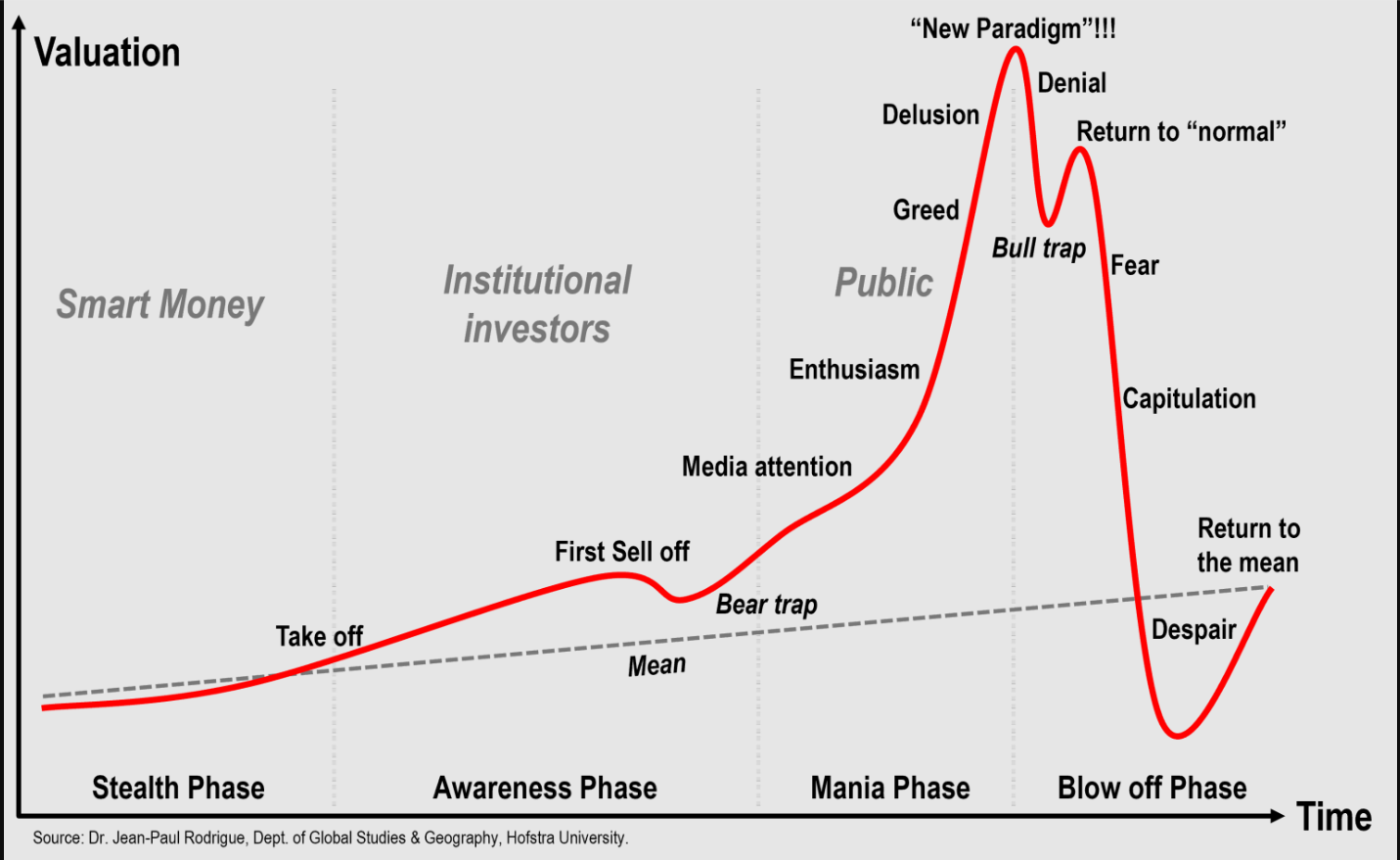
    The following chart, created by Dr. Jean-Paul Rodrigue, is a frequently referenced map of bubble progression. Where are we now? Squarely in the Mania Phase for sure, and most likely past Enthusiasm into Greed and Delusion.

    Pinprick (Reality)

    What has recently occurred that could be that proverbial pinprick? Consider some recent developments:

    • The recent report from MIT (as described in this article from Yahoo Finance), in which for “AI enterprise solutions” there has been something like a 95% failure rate.
    • The recent problematic release of OpenAI’s ChatGPT 5. Reactions vary from “lame” to disastrous. Sam Altman issued an apology of sorts. And a few wondering if LLMs have perhaps reached a kind of limit.
    • Recent announcements from competitors of Nvidia, such as the most recent one from the Chinese company Alibaba. The thing is, Nvidia hasn’t created some super technology that no one else can emulate some way, albeit involving a lot of intellectual effort and cost – namely, chips designed to work on large data sets and embody parallel processing. But many “investors” appear to believe Nvidia will always be the dominant, or even sole, player in this space.

    There are some other items to consider. Such as reports of surges in electricity bills for those living near some of the new data centers that are being built. Add problematic outcomes of usage of LLM models – weird results such as “hallucinations” that are not just concerning but eye-opening (see Addendum for an example). Even if there has been only a single or handful of outcomes such as suicide from someone seeking help relating to mental issues, it still doesn’t look good. The point is, systems like ChatGPT simply aren’t infallible.

    Then there are all the tech companies laying off or holding off on hiring, with CEOs saying outright they are filling roles with AI agents. A worrying number of new college grads are having difficulty landing that first job, and some of this can be attributed to AI usage – the unemployment rate for new grads is now well above the official unemployment rate.

    And speaking of high tech work, we see other reality checks. Earlier in the year the CEO of Anthropic (major AI player) confidently predicted that in six months 90% of new software would be written by AI – basically around the time of this writing (September). For one, we are not even close to that mark. But we are now getting reports of a software engineers finding themselves in a new role, namely, cleaning up problems in AI-generated code. One example involves security, with some security experts estimating that this code has about ten times the vulnerability in terms of security than code that has been written by humans. (to do bring in references – such as by Futurism)

    An Initial Reaction to Reality Meeting AI Hype

    In early August 2025 the market significantly pulled back in reaction to the report by MIT referenced above. Companies like Nvidia and Palantir Technologies saw their stock valuations crater. Part of the reaction was also a general reaction to high valuations of technology stocks.

    We can see this event as a kind of taste of what’s to come.

    And Then a Comeback

    But it didn’t take long for the market to recover… and surge to new (record) highs. Which are still in effect as of this writing, in September.

    For one, there were clarifications that the MIT report was really describing the failure of implementations of AI technology, not the technology itself. It’s not clear if this conclusively negates concern, but in any case “investors” took heart in this. Even so, a number of issues remain – note some of the problems described above. In the midst of a Mania phase, glimpses of reality have a shortened life.

    But this was then superseded by something else that ignited the enthusiasm (Greenspan’s irrational exuberance) of many “investors” in spectacular fashion. Namely, imminent rate cuts by the Fed! As has been seen before in history, expectations for cuts has acted like a drug (see Hopium). It’s really quite remarkable. Especially as once again looking through history, such cuts have almost always failed to have an immediate stimulative effect on the economy (note the chart in the Addendum). By the way, remember the cuts last fall? No? But maybe you forgot because… the economy continued to deteriorate. And it was deteriorating, a view bolstered by the recently released BLS report, which found that in the year up to this March (2025) the agency had misstated the number of jobs created by… 911,000. And then there was the surge of the long end of the yield curve (the one that mortgages for example are tied to)… upward.

    Reality

    But the stock market is only one aspect of extreme dynamics.

    Economically – with overlap with social and psychological reality – there is the huge divergence (and disconnect) between those enjoying asset prices that continue to surge (stock prices especially) and a much larger portion of the population that is at best struggling to keep their heads above water. The latter are dealing with the reality of increased cost of everyday living, showing up in groceries, rent, the cost of cars, insurance (auto, home, healthcare), medical costs (including premiums), as well as a number of other items. And then there is the true state of the job market – now being revealed as, simply, not good.

    But there are other things to consider. Such as the increased tension in social dynamics. As of this writing the assassination of MAGA figure Charlie Kirk has triggered an upsurge of toxic rhetoric in the wake of this killing (such as Democrats are part of a terrorist organization). There is a feeling that “knives came out,” with a slight cooling on learning that the shooter was a white kid from a solid Mormon family.

    This theme is far from being exhausted. There are all sorts of realities that remain despite optimism that continues (albeit now in weaker forms) concerning the economy and prospects for the empire.

    But I will end with just a quick reference to something much larger. Namely, the accumulating signs of deterioration in the biosphere. The warnings contained in a study by MIT that came out in 1972 (referenced in this article) can be used as a proxy for this overall situation. Some recent studies suggest that the gist of the report is still very much intact. And that we are headed for some sort of collapse by 2040. What’s troubling is that most can’t really address this issue – even if they acknowledge it – when dealing with financial and social issues that are in themselves overwhelming. So looming over our society – civilization – is reality: the consequences of our enormous and mostly deleterious effect on the planet. As per science fiction writer P. K. Dick’s quip about reality, just because a large portion of America – and the world – doesn’t believe there is much to worry about, such as the build up of CO2 leading to global warming, or the accumulation of micro-plastic throughout the biosphere (which includes our own bodies), doesn’t mean these problems will just fade away…

    Addendum

    So as of this writing the enthusiasm for AI is in place. But in researching for this post I came upon an example of AI hallucination that really encapsulates this problem.

    In this post a situation is described in which ChatGPT was asked “what is the world record for crossing the English channel entirely on foot?” It answered, and without hedging: “The world record for crossing the English Channel entirely on foot is held by Christof Wandratsch of Germany, who completed the crossing in 14 hours and 51 minutes on August 14, 2020.”

    Yeah, I definitely would stake my life on such technology.

    Reality of Fed Rate Cuts

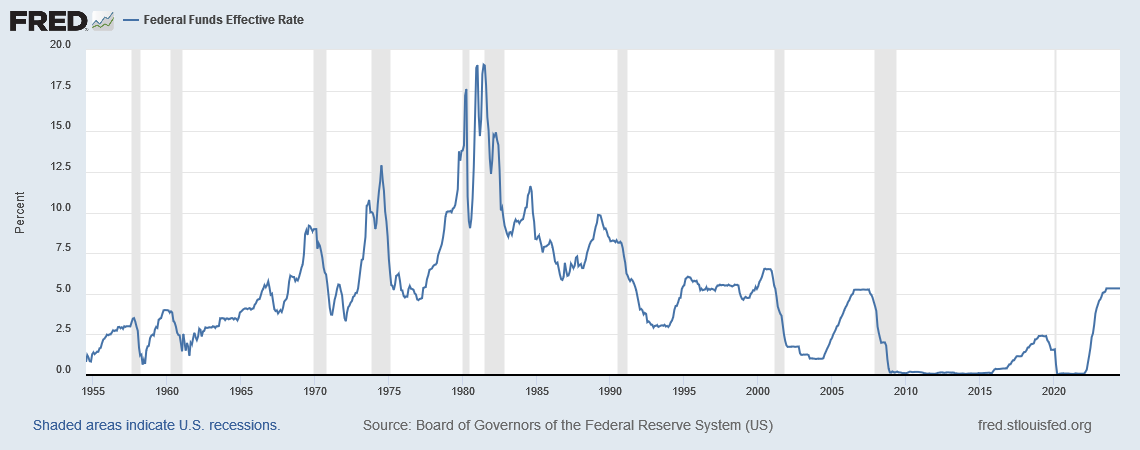
    Note the Fed funds rate in relation to recession (courtesy of the Fed itself). Do you see it? Not long after the Fed begins to cut rates, a recession occurs. Some will say they are too late, but the funds rate usually lags various bond rates, such as the two year Treasury. It can be argued that the bond market actually has a handle on the true state of things (economy), taking in consideration data points that many “investors” either outright miss or are too busy being bullish to care.

    Magical Thinking / Delusion

    There is an uncomfortable overlap of mania and delusion. The market is supposed to be a “voting machine” but many times is overtaken by psychology – such as we see in the Manic phase. BTW, on the opposite side of the coin is panic. Which leads to corrections and crashes. This manic behavior is very similar to that of a gambler.

    One theme to be developed is a possible connection, in terms of psychology, of the propensity for magical thinking in the face of a sense of a stalling and unraveling. Yes, hard to pin down, as it can’t be measured in the same way as, net worth or debt levels, for example. This sense comes out in various ways, but is mostly deflected by MSM and other means. This is The Mirage. What am I talking about? Check out large swaths of America that are shabby, showing signs of deep decay. Populated by a substantial portion of the population if not living in poverty, dealing with precarity. And includes millions who see Trump, for example, as a means to magically transform America into a new “Golden Age” (Trump’s words). As I write this I see this is something I want to develop further – so it constitutes a major “to do” in further posts.

    At the time of writing, mid September, there is a major example of this unraveling. Namely, the “knives are out” in the wake of a major MAGA figure’s assassination. Right, even as the rhetoric becomes disturbing, and tension rises… the market goes up!

  • Victory Laps on an Ice Shelf

    At the top of summer 2025, there is unbridled optimism among a portion of Americans: those at the top of the economic pyramid and others with the wherewithal to continue speculating in assets such as stocks and crypto. Aided by Cheerleaders in the MSM (see quote below), we get sentiment along the following lines: The economy is on a roll! Or about to take off! In any event, it is not in recession, and if one occurs it is still sometime off in the future. The tariffs are turning out to be a “nothing burger.” And so on. The problem is this optimism is not shared by a large number of Americans. And the economic data, if looked at in its entirety, is anything but a cause for celebration.

    In the midst of writing this post, the BLS came out with their July report. Hmm, only 73,000 new jobs were created in July. But what was shocking were the large revisions for previous months. Now we are getting a dose of reality, with an average of 35,000 jobs created over three months ending in July (prior three months saw an average of 128,000), and a meek 1.2% average annualized GDP reading for the first half of the year (vs 2.8% for 2024). The markets initially reacted with a modest selloff. However, in the following days that selloff was erased and the optimism appears to be intact (and the Party continues, perhaps with some doubts creeping in). We’ll see how long it can continue. But given there has been as yet no “severe” reaction, I will continue as if this news can be treated as a “bump in the road,” and that the “great news” remains.

    This quote of an analyst seems to encapsulate the prevailing view among those mentioned at the top of the post – those doing pretty damn well, damn any indication that the economy is anything but “robust:”

    No one expects the US economy to enter recession anymore.

    (Further update: as we continue into August, signs of doubt about the health of the economy are starting to pile up, some of them to be detailed below. However, the Party continues as the markets are still hitting all-time highs.)

    The Great News Concerning the US Economy

    So, what is the basis of such great news?

    Well, look at the stock market! Back to making all-time highs!

    And there is the historically low unemployment! Healthy amounts of new jobs are being created. The economy must be in great shape!

    Perhaps there remains some pesky inflation, but the current rate is a lot less from what was seen in the previous year.

    Oh, and we get a GDP print of 3.0 for Q2! Hallelujah!

    So much for any major hit from the tariffs. The Party is intact!

    But…

    It’s kind of annoying to have to put in the effort to go through the above indications and give the details that are left out – either by laziness or intentionally – at least by MSM.

    GDP and the Labor Market

    Let’s get the GDP out of the way. I will have to give the MSM credit for stating at the outset that the import component to the calculation made a large difference. Namely, the large decline in imports (a negative factor in the calculation) was a major factor in that modestly high GDP print. Of course, this was a result of tariffs. Another factor has been the so-called front-running of the tariffs – economic “activity” that is misleading as to the true state of the economy. This included a build-up of inventory in anticipation of tariffs.

    Mid-July the Federal Reserve put out its so-called Beige Book. This is the Fed’s take on the economy, which is broken down into 12 regions. In this report only 3 of the 12 regions showed growth, 2 of them only slightly. Not exactly an upbeat assessment.

    And then there are all those jobs! Except, many of them have turned out to be a… mirage. We’ll put aside the chiding from LISEP, for example, who point out how a large number of these jobs are basically bs jobs – with wages not coming close to providing the wherewithal to cover the cost of living that an increasing number of Americans are having difficulty keeping up with.

    But then the BLS came out with the July non-farm payroll numbers, along with revisions to prior months. And we got… a dose of reality. An average of 35,000 jobs created per month for the last three months (ending in July) should be the equivalent of being doused by a bucket of ice water. Also, the BLS notes that continuing claims remains elevated. This dovetails with anecdotal statements from a number of workers who report having difficulty finding work, especially in the tech sector. Corroborated by the University of Michigan survey, with an elevated % of those surveyed saying jobs are hard to find.

    Inflation

    Inflation, as measured by the CPI, has become, at best, subdued. There actually has in the last several months a slight uptick, such as in the related PCE. The latter could possibly be an indication that fallout of the tariffs has begun. One thing that many seem to miss, is that it was not realistic to think the fallout would be close to being immediate. A few voices, some major investors, pointed out that the effects would see a lag in roughly a six month time frame.

    But one thing with the CPI and related, is that inflation as being broadly measured is flawed. Folks “on the ground” are sounding an alarm, based on grocery bills that only seem to climb as time goes by. If we just look at food prices, a more realistic picture emerges: in the first half of 2025, food prices have increased 12.5%, way beyond the more tepid readings. How could this be? The CPI is looking at all sorts of goods and services, a broad range – when, for example, did you last purchase a TV (whose prices have moderated)?

    Stock Market

    The stock market is, in a word, in a bubble.

    There are a number of metrics that bolster such a view:

    • The Buffett Indicator
    • The CAPE Index
    • Breadth

    Tariffs

    So much for all the deals that Trump boasted on concluding. At the time of writing, after the extensions ended, full-scale tariffs have hit close to 70 countries. Except some extensions are still in place. Such as with China. Which only means the full-scale tariffs are not yet in place.

    A few people have noted that this on-again/off-again/abrupt change in course behavior makes it difficult for companies to make plans. This isn’t political: such behavior comes off as being fickle and, really, kind of dumb.

    What remains to be seen is when the full-on effects of the tariffs hit. As yet, so far there has been no major problem with prices, except we have seen evidence that some prices related to imports are indeed rising. But you got to love it, more than a few analysts/etc have made the simple statement that the effects of the tariffs will take months to fully manifest. I say that because there seems to be a number of analysts/commentators/etc who appear to implicitly believe that the effects should have been seen almost immediately – and since they weren’t, well… time for those Victory Laps!

    Analogy of Basal Melting

    The image at the top is a simplified view of basal melting. The basic point of the analogy is that the deterioration of the ice shelf as depicted occurs from below, as warmer water (“A”) eats away at the underneath of the ice. And it does so out of view.

    The Cheerleader type prancing about on the surface of the ice shelf thinks, wow, I don’t see any problem. Things must be fine! So much for the doomers. To rub it in the face of the latter the Cheerleader engages in a victory dance!

    And that encapsulates much of what passes for expert analysis these days.

    But out of direct view things are deteriorating. And direct view includes the data the majority of what the MSM chooses to present. The following is an enumeration of many of the signs that the economy is in a not-so-great shape. They interrelate in various feedback loops with each other, as well as other factors such large-scale climate patterns. They can be seen as cracks in the ice shelf.

    To organize them they are grouped by categories.

    Debt

    In a word, we are drowning in debt. In all major sectors: government, consumer, and corporate. We’ll focus on the consumer:

    • Total consumer debt, all categories: $18.4 trillion
    • Credit card debt: $ 1.2 trillion
    • Auto loans: $ 1.6 trillion
    • Student loans: $ 1.6 trillion

    That $18 trillion number, btw, is on par with the combined GDP of [ all of the ] Americas and the European Union.

    Delinquency and Default

    This category is basically Debt, but with a focus on increasing difficulty in handling the various types of debt.

    This should be another wake-up call, akin to those recent job numbers, with credit card debt, auto loans, and student loan delinquencies approaching 2010 GFC levels.

    One shocking element in this category is that the income group seeing the highest rate of rising delinquency are those making [ over $150k/ year – do do, check ].

    Labor Market

    The BLS has been having trouble reporting close-to-accurate figures for some time. They are reliant on surveys – two of them, the Establishment (business) and Household. The headline number given by the MSM is derived from the former.

    One component of the labor market is the number of those with continuing claims.

    Overall, some are calling the current situation “low hire, low fire.” The “low fire” part is deceptive –

    Housing

    The housing market has, in a word, stalled.

    Affordability [ lowest on record ]

    Commercial Real Estate

    This sector is in big trouble. And very little of the “cracks” in this sector is reported by the MSM.

    Sentiment

    Overall, sentiment among Americans has reached levels that reflect their condition…

    Cracks

    The preceding gives a picture of an economy that is at best stalling. One that is facing all manner of vulnerabilities. Vulnerabilities that could, with the right trigger, lead to major events such as mass layoffs, a stock market crash, and a financial crisis (with banks imploding, for example).

    The Victory Laps are basically a species of delusion. We are in the position of someone who believes, standing on a crumbling ice shelf, that what is beneath their feet is solid. Unable to see the deterioration that is otherwise hidden from their sight.

  • Red Pill for Liberals

    Ok, it’s time I put together material to counter the idea that many liberal-leaning folks have that it’s all a matter of Trump and MAGA. First though, I do want to say that I have nothing good to say about Trump. He is doing not just really stupid and mean-spirited shit, but a number of his initiatives are destructive in all sorts of ways (and in fact hastening the downfall of the American Empire). But the idea that he and his minions are solely responsible for the deteriorating state of the union just isn’t true. Trump is not a cause, but a symptom. Things have been unraveling for significant segments of our society for some time. And by that I mean the economy and the government (The System) have not only ceased to further the lives of many Americans, but has recently have had increasingly negative effects.

    The MAGA movement, that Trump exploited for his own political gain, must be seen in broader terms as a populist movement. Such movements emerge when the system in which they operate fails significant portions of society (see Turchin for instance to do bring in refs). They grow out of the soil of frustration. And one major factor leading to this frustration includes the stalling of economic opportunity for the working class.

    Some will point to elements of racism in MAGA. And there may be some, but I would say it’s more a matter of scapegoating. The backlash against immigration – a phenomenon that has occurred before in our past (to do refs to including No Nothing Party and the like) – is in part tied to a loss of well-paid, middle-class jobs. Of course this can be seen as based on faulty logic. But populism has always had its basis in emotion, not intellect. There has always been an element of anti-intellectualism. Which then leads to a distrust of and reaction to the “the powers that be,” politicians responsible for policy decisions as well as those who head our economy, the corporate leaders and the financial elite.

    Listen to these words from former Secretary of Labor Robert Reich, in an interview that came in the wake of the recent upset in the NY Mayoral race:

    The Reason People Are Fed up With Democrats – YouTube

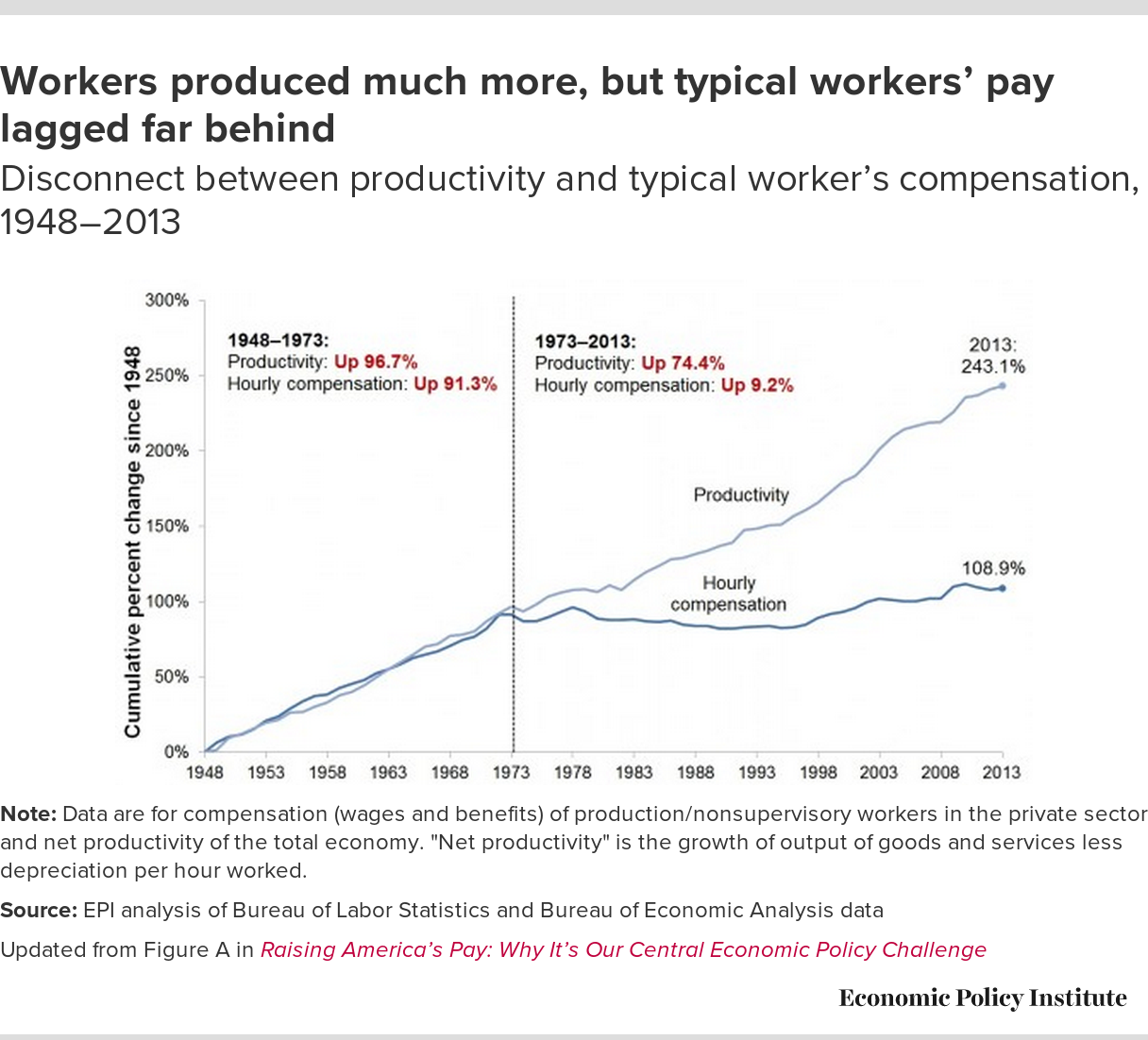
    He begins by saying there is a very large wave of anti-establishment (anti-elite) sentiment in this country. Why? Now this is where some need to start paying attention. Being conservative, “the bottom 60% of Americans have not seen a real wage increase in 45 years.” In the chart found below note the divergence around the mid-1970s. The following study by Pew Research – real wages “have barely budged in decades” – is one supporting reference.

    As Reich notes, many in that 60% (or so) group have done marginally better in that period, although this recently has begun to change (for the worse). But the bulk of new wealth creation since the 1970s has gone to the top tiers. A recent study by the RAND corporation, presented by Time magazine in this article, presents the same situation from another angle. The authors of the RAND study determined that from 1975 through 2018 roughly $47 trillion had been siphoned off by the top 1% from the bottom 90%, based on (and I am grossly summarizing) if income had kept up with things like productivity (as the following chart details).

    As Reich continues, “The economy is rigged.” Against the working class. A situation that Bernie Sanders for example has been warning about. The following graph by the Economic Policy Institute presents data concerning this.

    There are some analysts/experts who see a different picture. But you don’t have to do much searching to realize that something has gone wrong. For starters, there is a growing number of young adults who are definitely in worse financial shape than their parents at a comparable age. The prime example would be with housing, where we find the lowest affordability on record. Recent surveys show a decline in sentiment around questions such as “Do you believe in the American Dream?” (of course, we need to pin down what the Dream actually means; in this context it means the ability to have a comfortable life with the ability to save and move up the economic ladder) And such decline is higher among young adults, who find themselves increasingly priced out of the housing market.

    Reasons for the Frustration

    A number of developments have been identified that have led to the conditions giving rise to this frustration. Many of them have their roots in the mid-1970s, early 1980s time frame. They all had a part in the stalling of working-class wages.

    A decline in union membership is one such factor. Unions gave workers bargaining power. But particularly during the Reagan administration they came under attack (including from hostile policy) and lost membership. A number of reasons have been given but behind the scenes there was the simple desire by the corporate elite to increase profits. These profits of course led to increased compensation to that elite.

    The attacks on unions was part of a more general push by the elite to further their wealth. They were aided by a political shift embodied in the Reagan era that has been given the term neoliberalism, that saw free-market capitalism as the best approach to achieve general and increased prosperity. While it was touted that giving the markets free reign would benefit everyone, in practice it was only… the corporate and financial elite who saw the bulk of the fruits of these sorts of policies. Except for those involved in the so-called information economy, labor in general saw at best a stalling of opportunity; many working class saw their economic standing begin to deteriorate. Especially those who were the victims of the following:

    Another major factor was the push for off-shoring (globalization). And much of this involved manufacturing. This is a major topic in itself, but one main outcome involved a segment of the American working-class who found themselves screwed. For one, a number of factory workers lost their jobs. For the rest of them, there was downward pressure on wages (given the number of such workers now trying to find work in a sector with fewer slots). And there was another outcome: the so-called Rust Belt, a kind of industrial wasteland filled with shuttered factories… and shattered communities that had thrived on that type of work. It is no coincidence that such regions provided much of early adherents of the MAGA movement. Something obvious I have not encountered in discussions on globalization should be noted: namely, the workers and related communities had no say in this major upheaval. It was thrust upon them.

    Along with globalization came its twin, financialization. One facet of this was the prioritization of the shareholder (of stocks) over the worker. In addition to the rise of importance of the CEO and top C-suite execs. (to do: data )

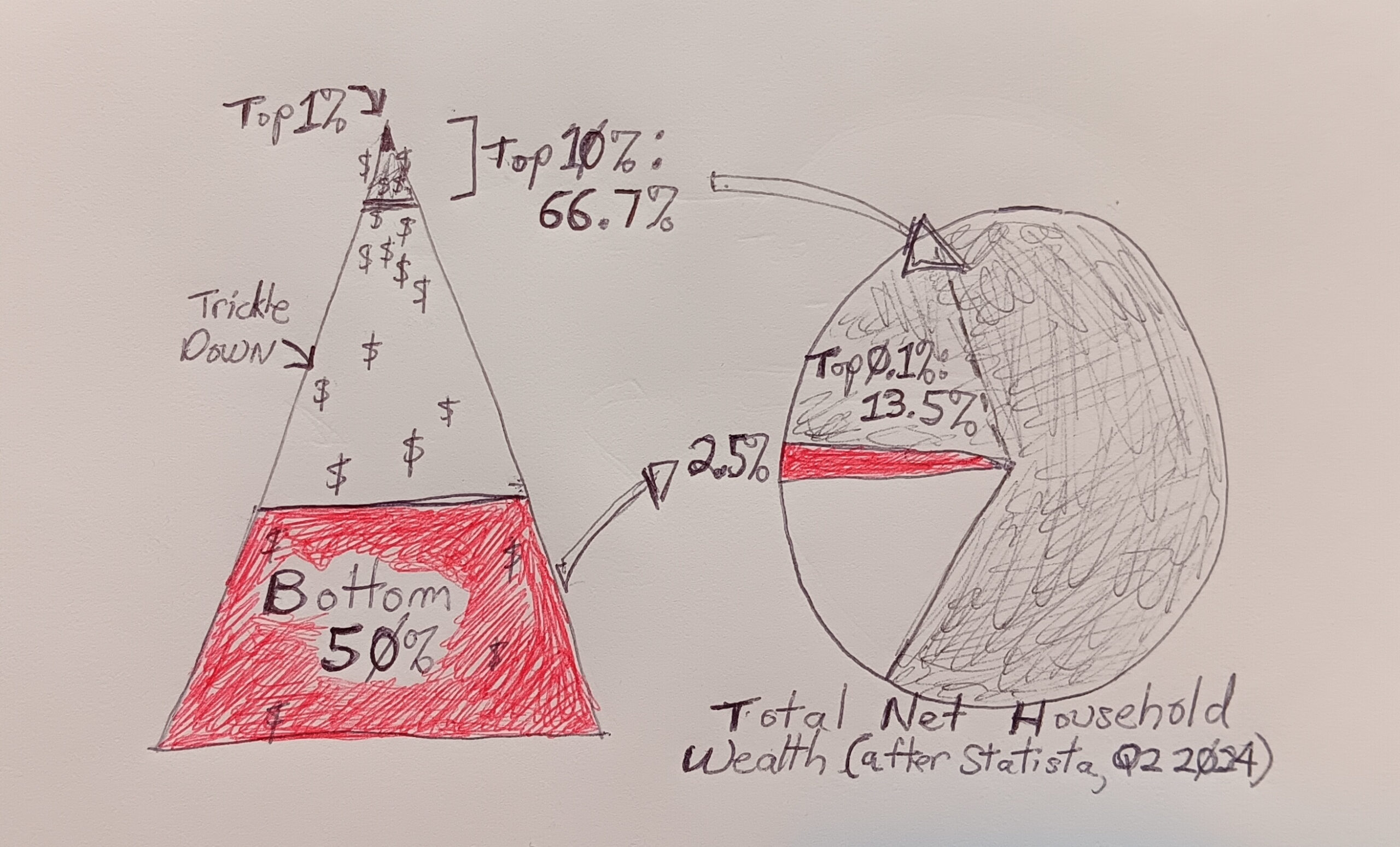
    And one major result of all this has been the diminution of the middle class, as well as the related increase of wealth inequality. This pie chart by Statista illustrates this inequality as of mid-2024. This chart is augmented in the following illustration to emphasize the huge discrepancy in our society in terms of the size of the income tiers. It reinforces the scenario that the wealth enjoyed at the top “thins out” (“trickles down”) as we descend through the income tiers. The working class, and lower parts of the middle class, have increasingly found themselves scrounging around for scraps.

    I won’t go into making the following connection more explicit, given it would entail a lengthy explanation, but it is no coincidence that with the diminishing of the middle class there has been an increase in political polarization. The middle class has acted as a kind of buffer from the more extreme ends of the political spectrum. With the decline of such buffering, and increase in economic frustration, we have some of the critical elements of a political backlash.

    The Election of 2024 and Bidenomics

    To return to the political angle, we must revisit the last election where the major issue was the economy.

    It was interesting during the run-up to the election to view the divergent takes on how well, or badly, the economy was fairing. On one hand Biden and top officials and much of the MSM touted not just a robust economy, but even a fabulously booming economy. Not a few still hold to this view. The government policies were collectively given the moniker Bidenomics. It included a bill that passed Congress called the Inflation Reduction Act. But in looking beyond the overjoyed commentary and headlines… it was really mainly a matter of deficit spending. Part of this spending included creating large numbers of government jobs (to do – numbers). These jobs along with other government spending helped in the GDP calculations, leading to healthy prints. And so we got overblown statements as to how great everything was for most Americans. The problem was, many of those Americans didn’t agree with this assessment.

    In survey after survey, the majority said the economy sucked. In the run-up to the election, polling found a solid 60% in swing states who agreed with the statement that “the economy is on the wrong track.” Larger %s were concerned with the cost of living. The MSM responded with commentary as to how many of such respondents were being misled or were delusional. If any of those just mentioned respondents heard such talk, it backfired. It only reinforced the skepticism (at best) or even hostility many in this group had toward those in charge, or their mouthpieces. Perhaps they still had a job, but they could sense, via their bank account and bills, that they were at best barely keeping their head above water.

    On top of the foregoing was the Kabuki theatrics of the Democratic Party. Who attempted to portray a vigorous president who was not evincing signs of cognitive decline. Who then realized – too late – the charade could not be maintained, and in sudden moves removed Biden as their presidential candidate and literally thrust Harris onto the stage.

    In a sense, Harris lost because of multiple charades. Even if many Americans couldn’t fully articulate them, they sensed something was “off,” that all the data that was presented that supposedly “proved” things were swell for the majority couldn’t negate.

    The larger problem, however, is that that sense of something being “off” was (and is) based on cracks in The System that had developed well before the present situation, and are beyond the means of the current political system to address. Details of such cracks are found in posts and commentary throughout this site.

    Of course, there is even larger problem. And that is even coming to terms with the foregoing will most likely do nothing to change the situation. Some of the “solutions” being touted by the Trump administration (such as tariffs) will probably end up making the situation even worse. This is, in my view, the tragedy of America, stumbling toward an end game – to be discussed in later posts.

    References

    Foreign Affairs – magazine, March/April 2025 issue

    Two articles in particular, The Broken Economic Order and The Post-Neoliberal Delusion (and the Tragedy of Bidenomics) reinforce the material presented above.

    The Revolt of the Elites by Christopher Lasch

    This 1995 work gives a warning for society and democracy when an elite gains too much power and wealth and disengages from a large part of the population. Their wealth can insulate them from the reality of the working and middle classes. The elite can also fall into a trap of becoming enveloped in contentious issues that a lot of the population are not necessarily invested in, at least in wholehearted way.

    Deer Hunting with Jesus

    Strangers in Their Own Land

  • Summer of 2025: And the Living Is…

    …easy. Or so the song goes (lyrics are from the opera Porgy and Bess).

    It’s easy for some, I guess. Like those set to benefit from the markets poised to make new all time highs (S&P 500 anyway, at the time of writing).

    (Update, on 6/27 the S&P 500 “squeaked” to a new record high – hurray!?).

    And what is the great news triggering the markets to shoot into the stratosphere?

    No WWIII, for one (f or the time being at least). And oil appears to not be surging into the stratosphere. But it’s not as if the dust has really settled. But many “investors” with ADHD (helped by Hopium) have concluded the bombing, for now, is done with and there is a cease fire between Israel and Iran. So time to move on!

    And speculation is increasing the Fed will cut rates sometime… soon. Oh joyous news that will be (even if the short term rates will do little to help much of anyone, at least in the short term; keep in mind mortgages, for one, are based on long-term interest rates, out of the Fed’s scope).

    But maybe there is no real reason other than the conviction that stocks are so close to all-time highs so it’s time to pile in. Generating wealth… for top income tiers… who are really the main beneficiaries of these manic surges.

    But really, how about a reality check?

    • Starting off, Q1 GDP has just been revised again. Down a bit. Hmm, not exactly great news. At -0.5% that means the economy was indeed contracting.
    • Continuing unemployment claims have been steadily rising. They are now at 1.937 million, the highest since November 2021.
    • Housing price drops are being reported in certain housing regions, such as the South. Could be good news, but then we get the headline: US New-Home Sales Drop by Most Since 2022 on Poor Affordability.
    • Oh, as to inflation: “core” PCE, the figure closely watched by The Fed, ticked up. Maybe not much, but it appears the best you can say is that it is sticky, not disappearing as some had hoped/predicted.

    More broadly:

    • We hear from both consumers (informally, on social media) as well as from corporate CEOs (Starbucks, McDonald’s, many other fast food franchises) that for growing numbers fast food has simply become too expensive. Remember when fast food wasn’t just about convenience but cost?
    • And at least some franchises have started to issue concern. Like Starbucks, with five consecutive quarters of declining sales.
    • Consumer debt (principally credit card) remains at record levels.
    • There is an uptick in delinquencies in this debt.
    • And more consumers are resorting to Buy Now, Pay Later (BNPL) plans. They are being used not just for discretionary items such as concerts (ex. Coachella, where it was found about 60% of tickets bought were on BNPL plans), but also for groceries. That is, for everyday expenses. Note that there is an uptick in such loans becoming delinquent or in default.
    • More debt: about one in three student loan borrowers risk default. That is about 5.8 million borrowers who were 90 days or more past due on loan payment, as of April 2025.
    • Speaking of college grads, the difficulty of many new grads with degrees like Computer Science in landing a job is getting attention. In some situations it appears that AI is at least partly to blame. Last I heard 1/3rd of software written at IBM is being done by AI.
    • Consumer confidence, as tracked by the Conference Board, “unexpectedly” declined in June.
    • The list could go on and on. With horrible data for the housing market, for example (with low sales figures and rock bottom affordability). But I will end with this: corporate bankruptcies, where 188 companies filed for bankruptcy in the first quarter of 2025. This figure is the highest seen for this period since the Great Recession, and is a “significant increase” over the 139 filings for Q1 2024.

    Yep, a “solid” economy! (adjective used by The Oracle and MSM).

    The job market is not close to being “strong” as you will see being stated in MSM (just today, saw an article in The Guardian attempting to answer why college grads are having a difficult time, while the job market is “strong”). Inflation is still around, and paychecks are not keeping up for significant segment of the working population (remember, wages by themselves do not directly transfer to paychecks – hours worked is usually and conveniently left out). And there are signs the economy is not firing on all cylinders.

    One word for this: stagflation. The keyword for the Summer of Our Discontent.

    By the way, on top of the preceding that “big beautiful (stupid) bill” will end up gutting the safety net (for ex Medicare and SNAP). Some Americans, the most vulnerable, are set to lose big.

    Behind the platitude of “the living is easy” there is growing frustration and dismay. But the stock market, as hyped by the machinery of The Mirage, is fantastic. And there you have the current state of America in a nutshell, with winners drowning in “wealth” and a lot of Americans getting screwed.

    …..

    Some related thoughts:

    Much of the preceding would suggest something “big” is in the works. As in some sort of unpleasant financial event. And yet, the can continues to get kicked. More debt! Including even larger deficits that will result from that “big beautiful (stupid) bill.”

    Gershwin’s Porgy and Bess is an example of American Genius. It’s not that there aren’t interesting artists and acts in the current scene, but we seem to be bereft of real genius. Instead, for example in many mainstream movies, we get stale rehashings of stories that are being sequel’d to death. (It’s as if a lot of these stories are written by AI; come to think of it, there is talk of incursion of AI into Hollywood… with jobs, including for writers, on the chopping block)

    Lastly, a recent blog post from the Federal Reserve, Real GDP Growth by State is quite enlightening, and sobering. 39 of the 50 states saw contracting economies in the first quarter of 2025. Texas and California saw slight contraction, but because of the size of their economies that contraction is very significant.