Note: this page is undergoing a lot of change.
In broad strokes, the idea is simple, based on an analogy between life (biological systems) with phases of growth and senescence, and socioeconomic systems. The idea is that nations and empires similarly experience phases of development and disintegration. The idea might seem overly simple, but at least until recently it has been largely and sternly dismissed in regards to the United States. As with the thesis that America is solidly in a phase of decline. For this observer and author, there is no question we are in decline. However, it would appear there has been some shift with growing acknowledgement that “something is very wrong” with the current state of affairs, somewhat offset by passionate cheerleading that the US is still the greatest nation on earth and similar sentiments.
The idea is quite old and has been expressed in various ways by a myriad of sources through the ages. The following is a quote from Seneca around the time of Roman emperor Nero: “Fortune is of sluggish growth, but ruin is rapid.” Here he states the declining phase may well unfold much quicker than the preceding growth phase (btw, Dalio believes he sees a ratio of 5:1 in terms of relative time length, so that the idealized parabola becomes the lopsided curve known as Seneca’s Cliff). And then there is work of ibn Khaldun, which includes the concept of asabiyyah – which can be translated into “group feeling.”
Less recent (but still in the modern age) theory detailing this idea includes that of historians such as Toynbee (The Study of History).
Current work particularly relevant in this site is the work of Peter Turchin (Cliodynamics; Ages of Discord) as well as studies of empires by Ray Dalio, notable as the founder of Bridgewater Associates (Dalio is an example of the few billionaires who have pursued wider interests beyond buying $100 million yachts and the like). Other researchers/historians/etc could be mentioned. Turchin and Dalio are featured here as their work is very much current; in addition they back up their theses with a large amount of data.
THE BIG CYCLE
This term is taken by writings of Ray Dalio…
but the idea behind the Big Cycle goes way back
RISE AND DECLINE
some details…
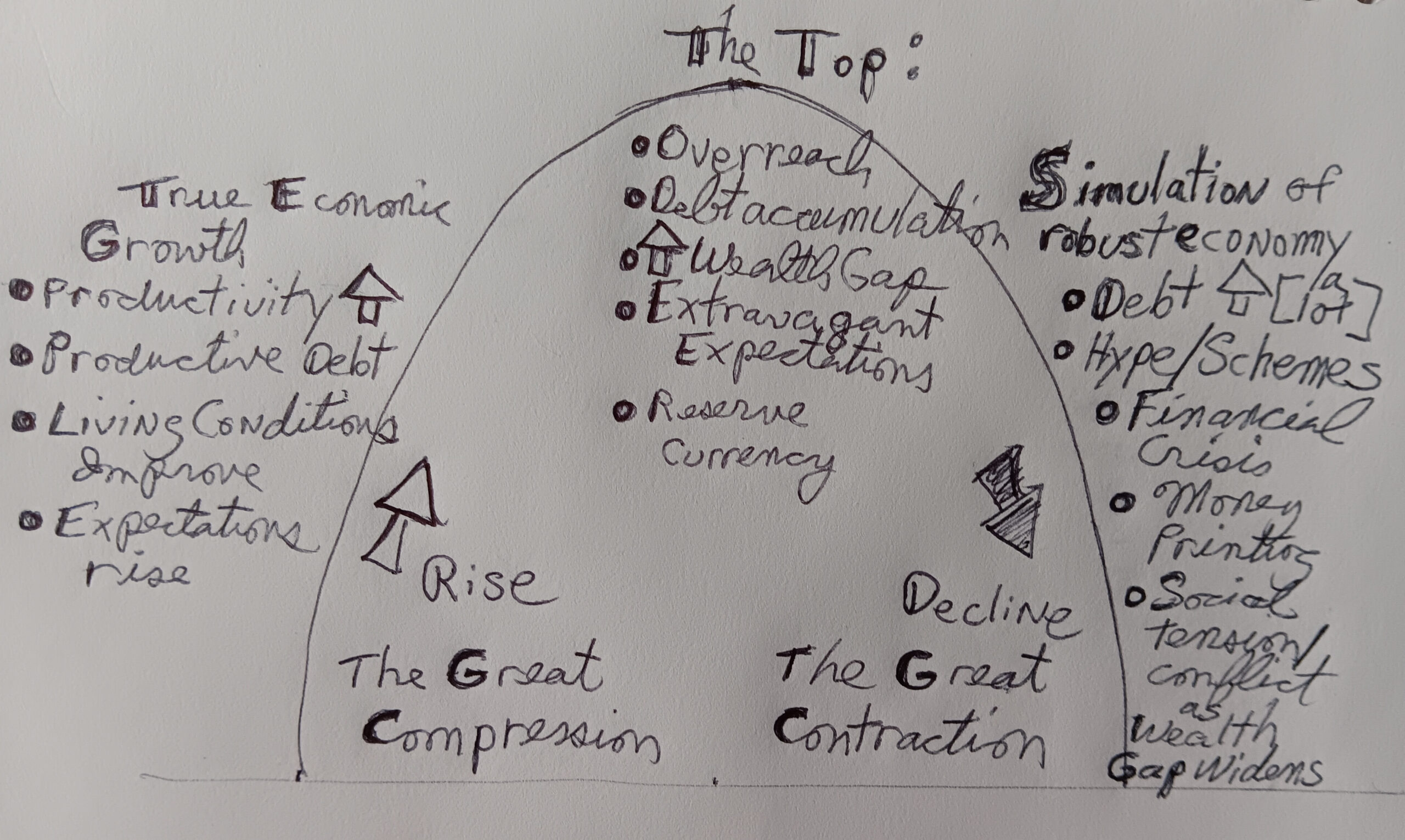
The above diagram is an oversimplified conceptual map that takes off from Dalio in what he terms The Big Cycle. In the Rise…
i add some factors… to do
Even as the signs accumulate any potential is usually quickly dismissed (see Ostrich Mode). It would seem the MAGA movement is a reaction to a broadly felt “something isn’t working very well.” But as in any populist movement, the actual situation is not really appreciated. There is a sort of background feeling that something is off but this feeling animates issues such as immigration; that is, scapegoats are identified such as immigrants, that have nothing to do with
…
To do: summary of the Big Cycle as it pertains to the American Empire
This article found on LinkedIn, Seven Signs of an Empire’s End, by cultural historian Dr. Ernest Richard Rugenstein, gives a useful checklist that can be used to determine America’s current state in relation to the Decline phase. Other examples of such lists can be found.
- Fixation on an ideology – for us, it’s something referred to as American Exceptionalism (we’re the best, the greatest nation in the world, etc etc).
- “Superiority of Amusement” – for Rome, it was Bread and Circus; for America, we have a stupefied population immersed in media that is now (progress!) available 24×7, and available just about anywhere on the planet.
…..
REALITY AND ILLUSION (DELUSION)
mapping onto the broad phases of Rise and Decline as seen in the annotations of the image at top
The Mirage… simulation – of what no longer exists…
A FEW COMMENTS ON AI
Example of innovation but can use the analogy of the mirage: many see something in the current AI boom (based on LLMs) that isn’t really there…