This post is focused on a possible near-term event, namely a high probability of a stock market correction – possibly a very deep one, leading to usage of the word “crash.” But also hints of other aspects relating to reality, or rather, activities and trends that are in various ways are in contradiction to what actually is the case. And which I take as symptoms of The Decline.
In broad strokes the market has greatly diverged from the real economy. By a number of metrics it is extremely overvalued. The prime example is the Buffett Indicator, which has now reached a record 210%. Adding to this is the red flag of a concerning low level of breadth, with a small group of stocks (“Magnificent Seven”) accounting for the bulk of recent gains for the NASDAQ and S&P 500 (both in record territory – even as the signs accumulate of deterioration in the real economy).
In a word, the market is in a bubble, Those who say we can only identify a bubble in hindsight are at best clueless. Especially as we note the extreme concentration in a handful of stocks that are most tied to AI development. The usage of the term “bubble” is showing up more in a number of places. Of all people Sam Altman of OpenAI has said succinctly that we’re seeing an AI-based bubble.
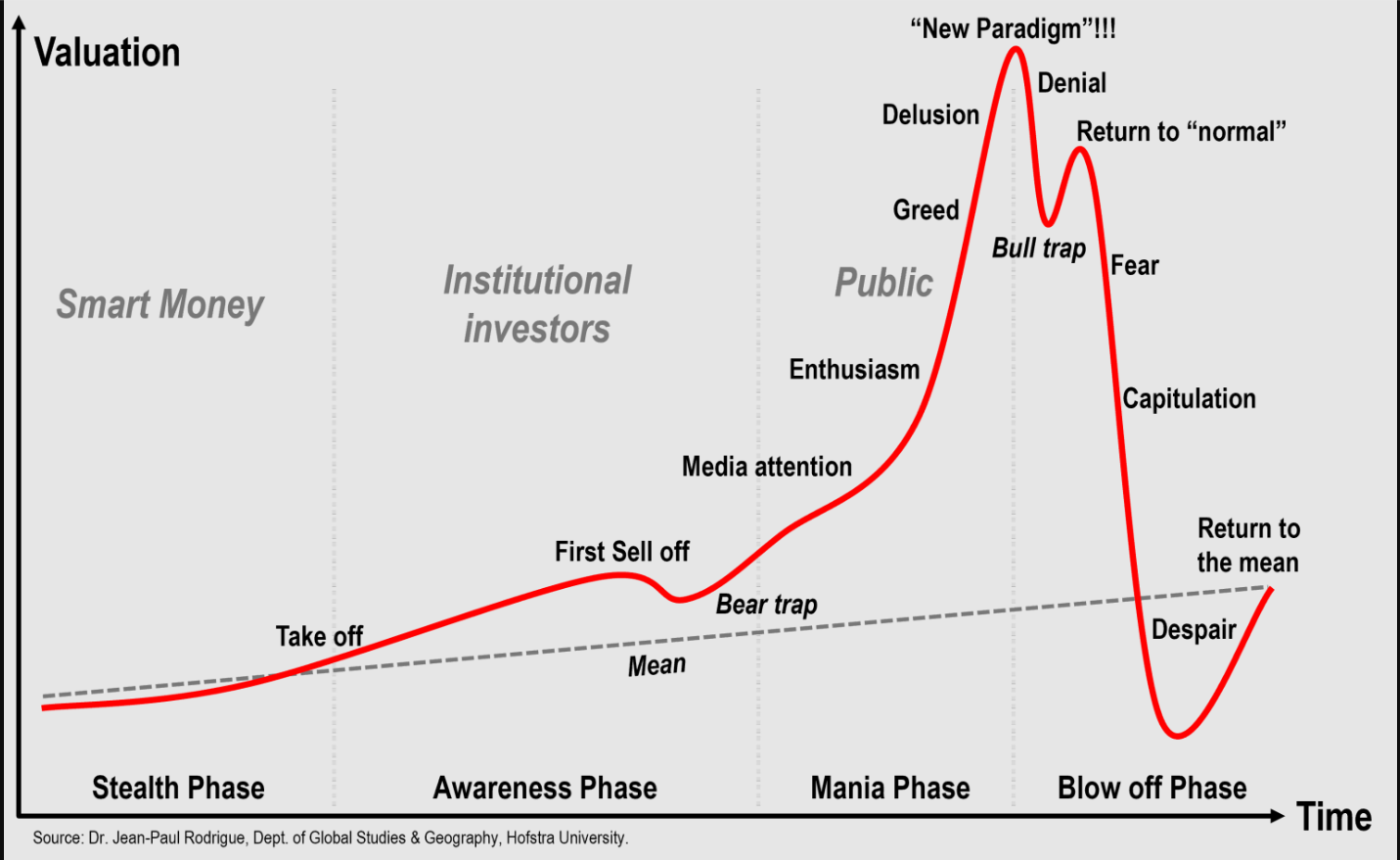
The following chart, created by Dr. Jean-Paul Rodrigue, is a frequently referenced map of bubble progression. Where are we now? Squarely in the Mania Phase for sure, and most likely past Enthusiasm into Greed and Delusion.
Pinprick (Reality)
What has recently occurred that could be that proverbial pinprick? Consider some recent developments:
- The recent report from MIT (as described in this article from Yahoo Finance), in which for “AI enterprise solutions” there has been something like a 95% failure rate.
- The recent problematic release of OpenAI’s ChatGPT 5. Reactions vary from “lame” to disastrous. Sam Altman issued an apology of sorts. And a few wondering if LLMs have perhaps reached a kind of limit.
- Recent announcements from competitors of Nvidia, such as the most recent one from the Chinese company Alibaba. The thing is, Nvidia hasn’t created some super technology that no one else can emulate some way, albeit involving a lot of intellectual effort and cost – namely, chips designed to work on large data sets and embody parallel processing. But many “investors” appear to believe Nvidia will always be the dominant, or even sole, player in this space.
There are some other items to consider. Such as reports of surges in electricity bills for those living near some of the new data centers that are being built. Add problematic outcomes of usage of LLM models – weird results such as “hallucinations” that are not just concerning but eye-opening (see Addendum for an example). Even if there has been only a single or handful of outcomes such as suicide from someone seeking help relating to mental issues, it still doesn’t look good. The point is, systems like ChatGPT simply aren’t infallible.
Then there are all the tech companies laying off or holding off on hiring, with CEOs saying outright they are filling roles with AI agents. A worrying number of new college grads are having difficulty landing that first job, and some of this can be attributed to AI usage – the unemployment rate for new grads is now well above the official unemployment rate.
And speaking of high tech work, we see other reality checks. Earlier in the year the CEO of Anthropic (major AI player) confidently predicted that in six months 90% of new software would be written by AI – basically around the time of this writing (September). For one, we are not even close to that mark. But we are now getting reports of a software engineers finding themselves in a new role, namely, cleaning up problems in AI-generated code. One example involves security, with some security experts estimating that this code has about ten times the vulnerability in terms of security than code that has been written by humans. (to do bring in references – such as by Futurism)
An Initial Reaction to Reality Meeting AI Hype
In early August 2025 the market significantly pulled back in reaction to the report by MIT referenced above. Companies like Nvidia and Palantir Technologies saw their stock valuations crater. Part of the reaction was also a general reaction to high valuations of technology stocks.
We can see this event as a kind of taste of what’s to come.
And Then a Comeback
But it didn’t take long for the market to recover… and surge to new (record) highs. Which are still in effect as of this writing, in September.
For one, there were clarifications that the MIT report was really describing the failure of implementations of AI technology, not the technology itself. It’s not clear if this conclusively negates concern, but in any case “investors” took heart in this. Even so, a number of issues remain – note some of the problems described above. In the midst of a Mania phase, glimpses of reality have a shortened life.
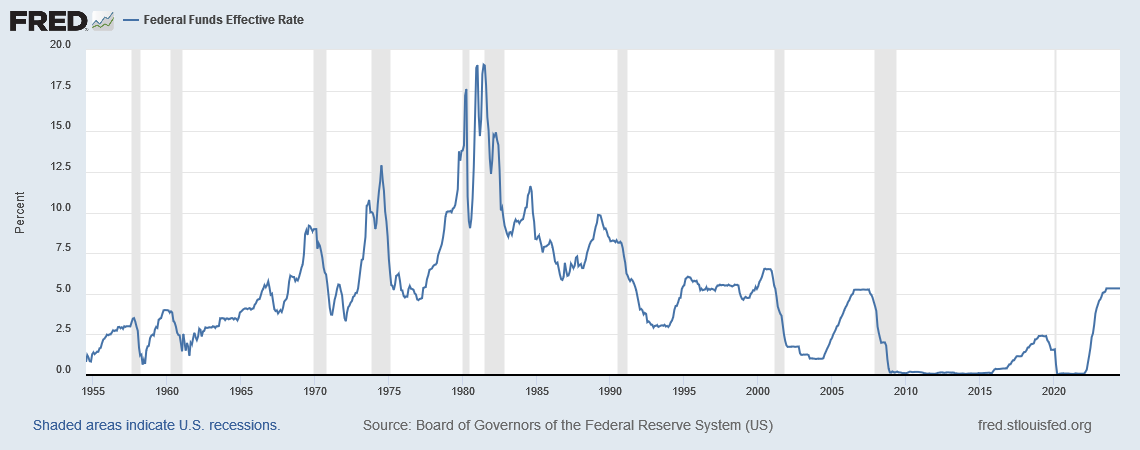
But this was then superseded by something else that ignited the enthusiasm (Greenspan’s irrational exuberance) of many “investors” in spectacular fashion. Namely, imminent rate cuts by the Fed! As has been seen before in history, expectations for cuts has acted like a drug (see Hopium). It’s really quite remarkable. Especially as once again looking through history, such cuts have almost always failed to have an immediate stimulative effect on the economy (note the chart in the Addendum). By the way, remember the cuts last fall? No? But maybe you forgot because… the economy continued to deteriorate. And it was deteriorating, a view bolstered by the recently released BLS report, which found that in the year up to this March (2025) the agency had misstated the number of jobs created by… 911,000. And then there was the surge of the long end of the yield curve (the one that mortgages for example are tied to)… upward.
Reality
But the stock market is only one aspect of extreme dynamics.
Economically – with overlap with social and psychological reality – there is the huge divergence (and disconnect) between those enjoying asset prices that continue to surge (stock prices especially) and a much larger portion of the population that is at best struggling to keep their heads above water. The latter are dealing with the reality of increased cost of everyday living, showing up in groceries, rent, the cost of cars, insurance (auto, home, healthcare), medical costs (including premiums), as well as a number of other items. And then there is the true state of the job market – now being revealed as, simply, not good.
But there are other things to consider. Such as the increased tension in social dynamics. As of this writing the assassination of MAGA figure Charlie Kirk has triggered an upsurge of toxic rhetoric in the wake of this killing (such as Democrats are part of a terrorist organization). There is a feeling that “knives came out,” with a slight cooling on learning that the shooter was a white kid from a solid Mormon family.
This theme is far from being exhausted. There are all sorts of realities that remain despite optimism that continues (albeit now in weaker forms) concerning the economy and prospects for the empire.
But I will end with just a quick reference to something much larger. Namely, the accumulating signs of deterioration in the biosphere. The warnings contained in a study by MIT that came out in 1972 (referenced in this article) can be used as a proxy for this overall situation. Some recent studies suggest that the gist of the report is still very much intact. And that we are headed for some sort of collapse by 2040. What’s troubling is that most can’t really address this issue – even if they acknowledge it – when dealing with financial and social issues that are in themselves overwhelming. So looming over our society – civilization – is reality: the consequences of our enormous and mostly deleterious effect on the planet. As per science fiction writer P. K. Dick’s quip about reality, just because a large portion of America – and the world – doesn’t believe there is much to worry about, such as the build up of CO2 leading to global warming, or the accumulation of micro-plastic throughout the biosphere (which includes our own bodies), doesn’t mean these problems will just fade away…
Addendum
So as of this writing the enthusiasm for AI is in place. But in researching for this post I came upon an example of AI hallucination that really encapsulates this problem.
In this post a situation is described in which ChatGPT was asked “what is the world record for crossing the English channel entirely on foot?” It answered, and without hedging: “The world record for crossing the English Channel entirely on foot is held by Christof Wandratsch of Germany, who completed the crossing in 14 hours and 51 minutes on August 14, 2020.”
Yeah, I definitely would stake my life on such technology.
Reality of Fed Rate Cuts
Note the Fed funds rate in relation to recession (courtesy of the Fed itself). Do you see it? Not long after the Fed begins to cut rates, a recession occurs. Some will say they are too late, but the funds rate usually lags various bond rates, such as the two year Treasury. It can be argued that the bond market actually has a handle on the true state of things (economy), taking in consideration data points that many “investors” either outright miss or are too busy being bullish to care.
Magical Thinking / Delusion
There is an uncomfortable overlap of mania and delusion. The market is supposed to be a “voting machine” but many times is overtaken by psychology – such as we see in the Manic phase. BTW, on the opposite side of the coin is panic. Which leads to corrections and crashes. This manic behavior is very similar to that of a gambler.
One theme to be developed is a possible connection, in terms of psychology, of the propensity for magical thinking in the face of a sense of a stalling and unraveling. Yes, hard to pin down, as it can’t be measured in the same way as, net worth or debt levels, for example. This sense comes out in various ways, but is mostly deflected by MSM and other means. This is The Mirage. What am I talking about? Check out large swaths of America that are shabby, showing signs of deep decay. Populated by a substantial portion of the population if not living in poverty, dealing with precarity. And includes millions who see Trump, for example, as a means to magically transform America into a new “Golden Age” (Trump’s words). As I write this I see this is something I want to develop further – so it constitutes a major “to do” in further posts.
At the time of writing, mid September, there is a major example of this unraveling. Namely, the “knives are out” in the wake of a major MAGA figure’s assassination. Right, even as the rhetoric becomes disturbing, and tension rises… the market goes up!